
We tend to treat coughing and wheezing as the lungs' "alarm system." And so a winter without coughing or wheezing often leads us to assume —that the lungs are perfectly safe, even more stable than usual.
But this may be the greatest illusion of all: winter is precisely the season in which lung health is most easily enveloped by "silent threats."
! The Silent Threat: Three Layers of "Pressure" on the Lungs in Winter
The truth about lung health is far more complicated than whether or not you cough. When everything seems calm and quiet, your lung cells may in fact be bearing three layers of "silent pressure":
The Physical Impact of Cold, Dry Air No.1
Once inhaled, cold and dry air directly lowers the humidity and temperature of the respiratory mucosa, weakening its ability to serve as the body's first line of defense.
More importantly, low temperature significantly reduces the beating frequency of the airway cilia.
These microscopic "cleaning brushes" are responsible for sweeping inhaled particles and pathogens outward. Once their efficiency drops, it means the deep self-cleaning capacity of the lungs is weakening.
The "Chronic Siege" of Indoor PollutantsNo.2
With doors and windows kept shut through winter, indoor concentrations of PM2.5 and volatile organic compounds (VOCs) are often higher than we imagine.
These fine particles do not merely settle on the airway surface; they can travel deep into the alveoli and even enter the bloodstream, remaining lodged in lung tissue for a long time. The problem they bring is not acute irritation but persistent low-grade oxidative stress and chronic inflammation.
This inflammation is like a small, unremarkable flame: it will not set off violent coughing right away, yet over time it interferes with the metabolism, repair and renewal of lung cells.
The "Seasonal Fatigue" of the Immune System No.3
Winter is the peak season for respiratory infections. Even when they never develop into overt disease, frequent mild infections keep the immune system of the lungs in a prolonged state of "alert."
This state continuously consumes antioxidant reserves (such as glutathione) and metabolic resources, crowding out the energy that would otherwise go to tissue repair and the maintenance of stability.
! How Does Risk Accumulate in Silence?
The most dangerous thing about these "silent pressures" is that they are long-lasting, cumulative and slow to unfold.
Persistent chronic inflammation and oxidative stress keep inflicting micro-damage on the DNA of lung cells. The body does have repair mechanisms, but across a prolonged cycle of "damage – repair – re-damage," the probability of a repair error rises markedly.
The process can be understood as: chronic inflammation (the source of fire) → DNA micro-damage (structural cracks) → faulty repair (botched patching) → abnormal proliferation (a structural hazard). Until, one day, a single "botched patch" happens to flip the switch for unlimited cell proliferation, and a tiny precancerous lesion or early tumour — invisible to imaging — may quietly take hold.
This is exactly why lung disease, and lung cancer in particular, is called a "silent killer" — the stage at which it is most open to intervention is often precisely the stage that offers no discomfort to warn us.
! When the Lungs Stop "Warning You," How Can Risk
Be Seen?
So how do we hear the thunder within the silence? What other means are available to tell whether the lungs are under abnormal pressure?
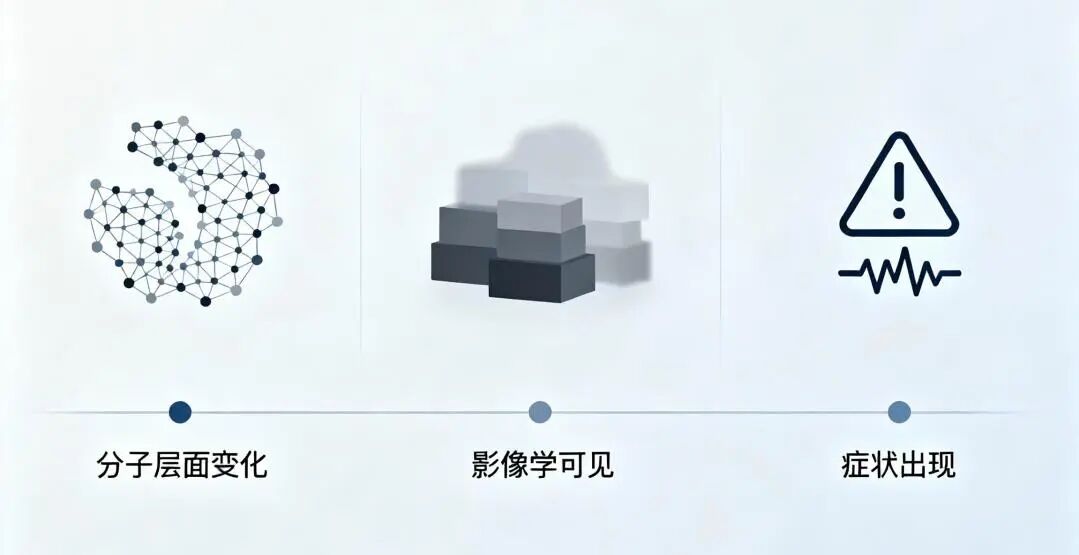
The answer is: to move our attention forward, from "sensation" to changes at the cellular level.
When lung cells become dysfunctional or develop early abnormalities under long-term stress, their metabolic processes drift in subtle ways, and these shifts are reflected in the overall pattern of small-molecule metabolites in the blood.
These molecular-level changes often appear earlier than any imaging abnormality, and earlier than any subjective symptom.
A Further-Upstream Way of Observing
Built on this scientific logic, LuCa™ offers an observational path different from conventional imaging-based screening.
It combines nuclear magnetic resonance (NMR) detection with a Transformer deep learning model, analyzing the multidimensional signal features of small-molecule metabolites in plasma to identify molecular patterns that are associated with early abnormal lung risk but have not yet formed a defined lesion.
During model training, the system learns and calibrates on large-scale real-world samples, enabling it to capture — amid complex and faint metabolic changes — the combinations of signals that indicate a shift in the risk environment.
It should be emphasized that this approach is not intended to replace imaging examinations or clinical diagnosis. Rather, before symptoms or imaging abnormalities appear, and beyond the annual check-up, it offers "high-risk groups" (such as long-term smokers, people with a family history, and those with prolonged exposure to polluted environments) — as well as anyone focused on managing lung health — an earlier, more forward-looking perspective on risk.
In winter, the season in which the lungs are most easily overlooked, a molecular-level assessment is more like a proactive "health audit." It means we no longer wait passively for the body to sound a deafening alarm; instead, while the window is still silent, we use scientific data to understand risk in advance.
After all, the best treatment is always prevention; and the most sophisticated prevention begins with the earliest possible insight into risk.
