
In the era of precision medicine, proteomics is regarded as the omics technology closest to the functional essence of life. Where genomics supplies the "blueprint," proteins are the molecular layer that actually carries out physiological functions and reflects disease states.
As one of the founders of proteomics and mass spectrometry, Professor Matthias Mann has witnessed and driven the field's pivotal evolution over the past 25 years. In a recent interview marking GenomeWeb's 25th anniversary, he reviewed the trajectory of proteomics and offered a notably sober assessment:
▇ The technical capabilities of proteomics have grown exponentially, but the changes it has brought to clinical medicine still lag far behind the pace of the technology itself.
 From "Seeing a Protein" to "Seeing a Cellular System"
Looking back at the development of proteomics, its history is essentially one ofever more complex objects of study.
In the early days, mass spectrometry could only help researchers "see" large protein molecules. As the technology advanced, individual proteins, protein mixtures, protein complexes and even organelles came within reach of systematic analysis. Roughly 15 years later, humanity achieved the first complete mapping of a eukaryotic proteome.
Since then, proteomics has entered a phase of exponential growth. Today, researchers can perform proteomic analysis at cell-type resolution in vivo and are even moving toward the single-cell scale. This progress has not come from a single breakthrough, but from coordinated advances across the entire technology chain—sample preparation, liquid-phase separation, mass spectrometry detection and bioinformatics.
An "Exponential Leap" in Technical Capability
Over the past 25 years, the most striking change in proteomics has come fromthe overall improvement of mass spectrometry and its associated workflows.
The performance of the mass spectrometers themselves has increased roughly 100,000-fold, with no sign of the trend slowing. At the same time, the entire workflow—from sample preparation and high-performance liquid chromatography separation to data acquisition and computational analysis—is continually being re-engineered and optimized.
The direct result is this:
researchers can now identify around 8,000 proteins in a cell line within 5 minutes, completing proteomic analysis of hundreds of samples in a single day. Twenty years ago, this was almost inconceivable.
Proteomics has thus evolved from a "low-throughput, specialist technique" intoa measurement platform with genuine potential for scale.
 Long in the "Shadow," but Not a Failure
Compared with genomics, proteomics has long seemed to make "less noise." The success of the Human Genome Project and of deep sequencing technologies brought enormous attention to genomics in both research and clinical settings.
From another perspective, however, proteomics has improved by a factor of roughly one million relative to traditional biochemical methods. It is not developing slowly; it is simply travelinga more complex and more engineering-intensive road.
Proteomics must not only "measure accurately," but also contend with practical challenges such as high sample complexity, wide dynamic range and extremely demanding requirements for quantitative stability. These factors give it a development rhythm quite different from that of genomics.
 The "Reality Gap" in Clinical Translation
Among all application scenarios,clinical proteomicsis seen as the direction with the greatest disruptive potential—and also the greatest difficulty.
Ideally, a single plasma proteomics assay would consolidate the many biochemical and immunoassay markers in use today, comprehensively reflect the state of the human body, and thereby markedly improve diagnostic accuracy. Yet this vision has not yet been realized.
The reason is not that proteins "cannot be measured." It is that clinical medicine places demands on technology far higher than those of a research experiment:
stability, reproducibility, interpretability, cost control and regulatory compliance—none can be missing.
Professor Mann also concedes that even genomics and transcriptomics, over the past two decades, have changed clinical medicine far less than the optimistic expectations of the time. Proteomics faces the same reality:technology advances exponentially, but entry into clinical practice moves in a straight line.
 Where Proteomics Is Truly Irreplaceable: Post-Translational Modifications
Among its many applications, proteomics holds one core advantage that no other omics can replace—post-translational modifications (PTMs).
Gene sequencing cannot directly detect the modification state of proteins at the functional level, whereas mass spectrometry can precisely locate both the type and the site of a modification through changes in molecular weight. Today, researchers can analyze tens of thousands of phosphorylation sites at scale from extremely small sample amounts.
These modifications often determine directly whether a signaling pathway is activated and how metabolic state shifts; they are also a key molecular basis of disease onset and drug response. In the future, PTM-based proteomics may enter precision medicine scenarios earlier than "total protein measurement" does.
 "Impossible" Single-Cell Proteomics Is Now a Reality
It is worth noting that even Professor Mann himself once underestimated the long-term potential of the technology.
Five years ago, he considered single-cell proteomics all but impossible, since the protein content of a single cell is extremely low. Today, however, researchers can routinely identify about 5,000 proteins from a single cell.
This confirms once again a familiar pattern:
we tend to overestimate technology in the short term and underestimate it in the long term.
 Looking Ahead: Combining AI With Systems Biology
Looking to the next decade, the key task for proteomics is not simply to keep pursuing "more powerful instruments," but to bring the capabilities that already exist into clinical practice and drug discovery.
Artificial intelligence will be deeply involved in proteomics on two levels: on the one hand, optimizing data acquisition, processing and interpretation workflows; on the other, helping researchers understand how complex systems respond as a whole to perturbation, moving beyond biology's traditional reliance on a single protein or pathway.
The combination of proteomics and AI may propel the life sciences from the study of "local mechanisms" toward genuine systems-level understanding.
 Closing thoughts
Looking back over the past 25 years, proteomics has completed a profound technological leap. Looking forward, its real challenge is no longer "can we measure it," but this:
how to make proteomics stable, reproducible and interpretable, and truly integrate it into the medical system.
This may well be the next critical leap that Matthias Mann is waiting for proteomics to make.
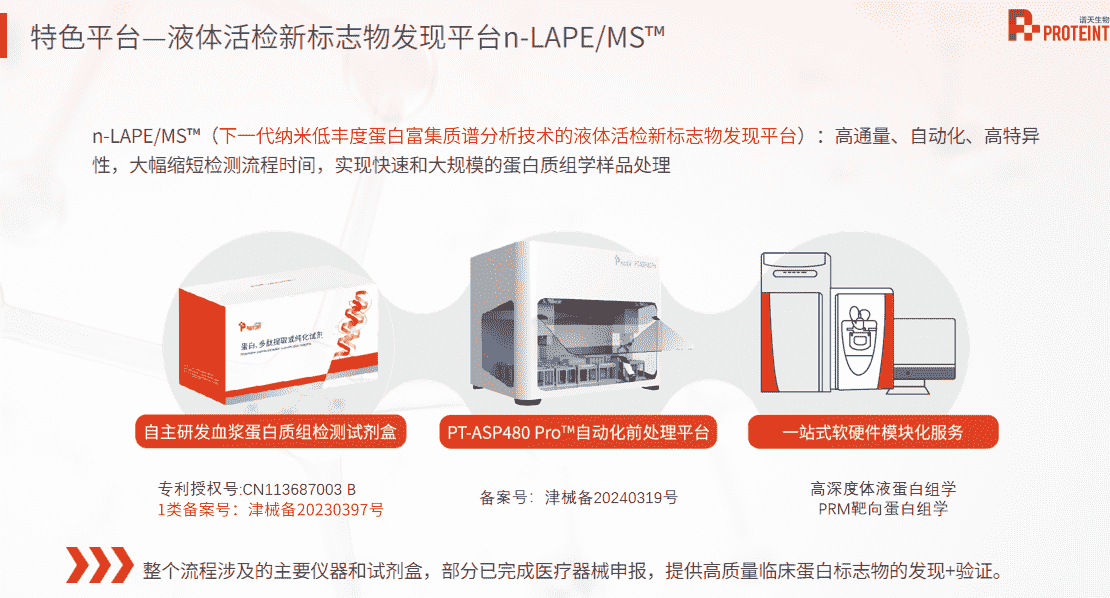
ProteinT: A One-Stop Proteomics Solution From Discovery to Validation
▼
ProteinT focuses on innovation and application in proteomics technology services, committed to providing reliable support for clinical translational research:
1 Deep coverage:
We offer whole blood/plasma/serum proteomics assays that mine low-abundance proteins in depth to support efficient biomarker discovery.
2 Targeted validation support:
We provide targeted proteomics validation services such as PRM/MRM, enabling absolute quantification of candidate biomarkers and large-scale clinical validation.
3 End-to-end partnership:
From early discovery to late-stage validation, ProteinT provides one-stop technical support to accelerate the implementation of precision medicine research.
Advancing science, serving health. ProteinT explores the boundless possibilities of life science omics together with you.
