
In the search for ways to predict recurrence of early-stage lung cancer, ctDNA and mRNA models once opened up new possibilities. Yet as their clinical use has deepened, one practical problem has gradually become apparent: at the critical stage following surgery for stage I disease, the stability of predictions remains insufficient.
When a detection signal appears and disappears, and results deviate between different time points or across different platforms, we are compelled to ask again:
what kind of molecular information can truly support decisions important enough to shape a treatment pathway?

Walk into the oncology department of any Grade A tertiary hospital and conversations like these are not uncommon:
"Doctor, my ctDNA was still negative three months ago—how can it have recurred at this follow-up visit?"
"Why is this mRNA report so different from the result our hospital produced before?"
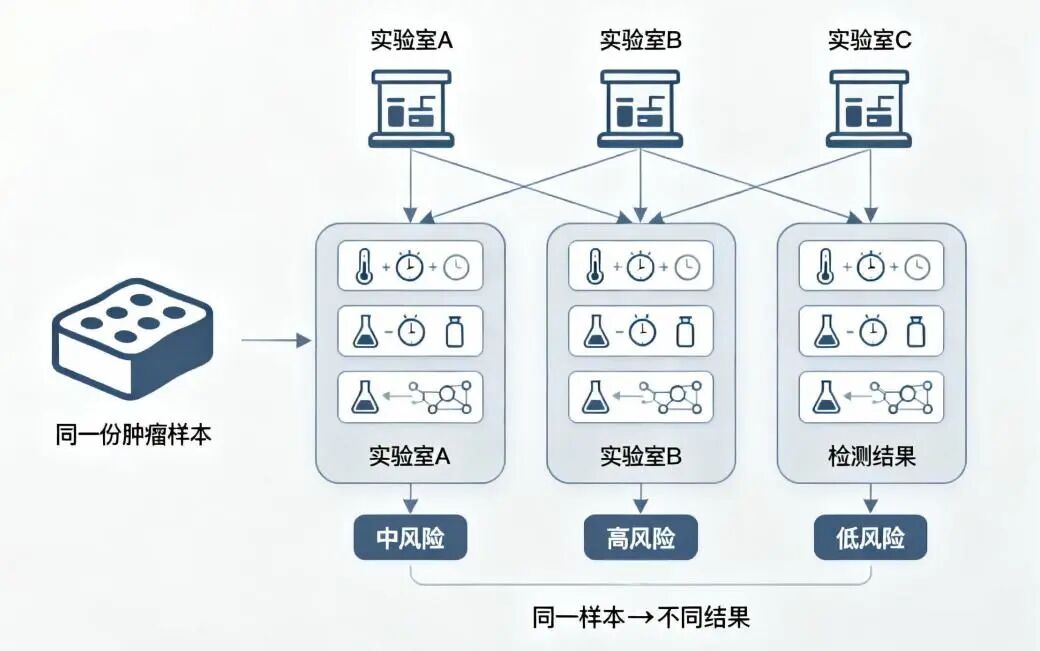
These questions point directly to the most intractable practical challenge in predicting recurrence of stage I lung cancer: the stability of molecular testing under conditions of low tumor burden.
① ctDNA: a sensitive signal, but highly dependent on "release conditions"
● Principle
ctDNA testing detects the DNA fragments released by tumor cells into the blood, and is an important form of liquid biopsy.
● The ideal scenario
Non-invasive, repeatable and suitable for dynamic monitoring.
In the post-operative stage I setting, however, it faces multiple limitations:
01 Highly variable release
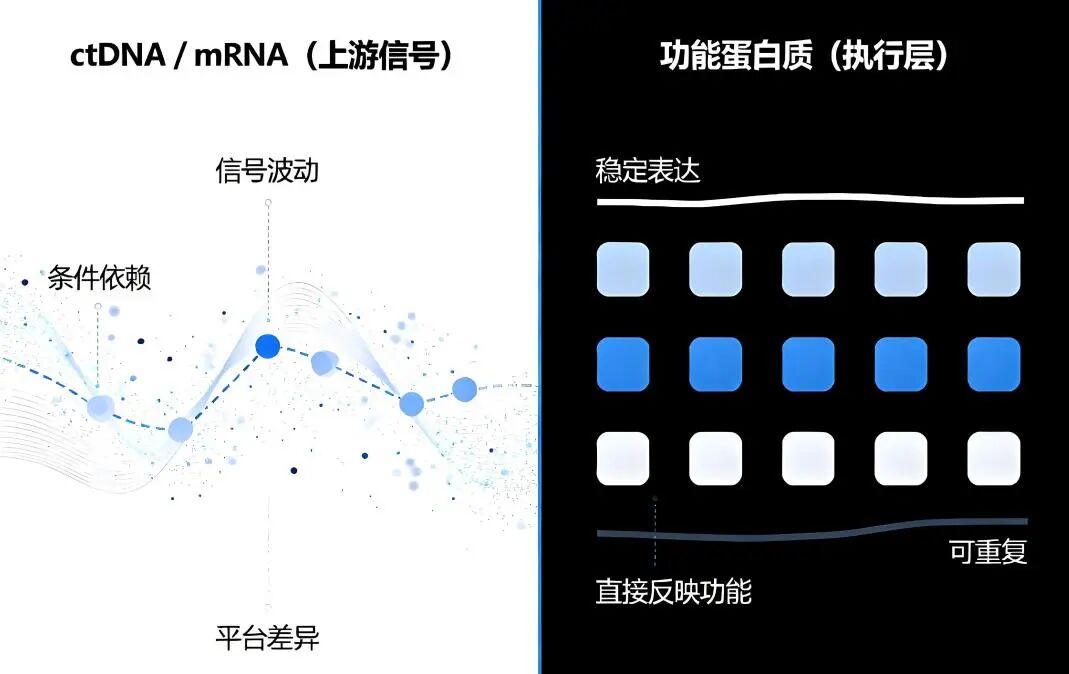
In early-stage lung cancer, ctDNA already sits at the lower limit of detection. Its release is influenced by tumor volume, blood supply and the microenvironment, causing results to fluctuate markedly between time points.
02 Insufficient spatial representation
Some lesions with invasive potential may release almost no ctDNA into the blood because of their dense local structure; a "negative" blood result does not mean the biology is "low risk."
03 A lag in the time dimension
ctDNA mainly enters the circulation after apoptosis or necrosis, so it tends to reflect biological events that have already occurred rather than a risk state that has yet to manifest.
● Clinical reality
In the post-operative stage I population, ctDNA is better suited as a monitoring tool after recurrence has occurred than as a stable means of assessing risk in advance.
② mRNA: closer to mechanism, but farther from the execution end
● Principle
mRNA reflects the level of gene transcription and is, in theory, closer to the functional layer than DNA.
In clinical practice, however:
01 The molecule itself is highly unstable
Sample handling, storage conditions and platform differences can all significantly affect results, and comparability between laboratories is limited.
02 Transcription is not translation, and translation is not function
High mRNA expression does not necessarily mean enhanced protein function:
● Translation may never occur
● The protein may be degraded rapidly
● Key modification states may not be activated
mRNA is therefore more like an "intermediate instruction" than the final executed outcome.
03 Limited applicability across subtypes
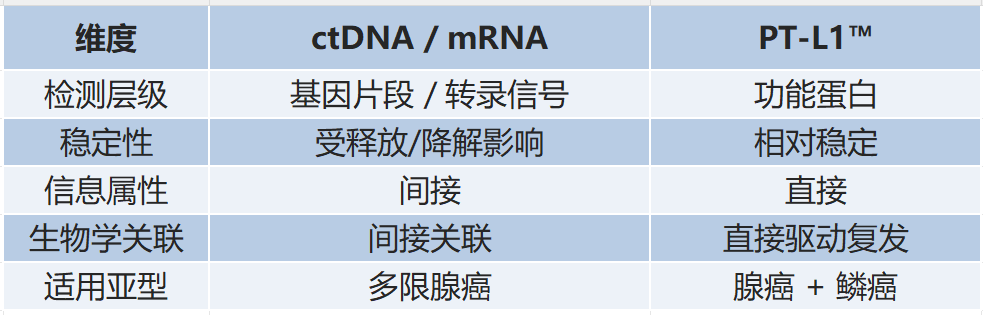
Most existing mRNA models were built mainly on lung adenocarcinoma cohorts, so their value in guiding care for patients with squamous cell carcinoma is limited.
③ PT-L1™: directly assessing whether "the capacity to recur already exists"
PT-L1™ does not follow the "upstream signal" path; it cuts directly into the execution layer of life activity—functional proteins.
Comparison of the core differences (a clinical perspective)—
④ How PT-L1™ ensures results are "usable and trustworthy"
01 Absolute quantification avoids amplification bias
Based on LC-MS/MS, 15 key functional proteins are absolutely quantified, avoiding the exponential amplification error introduced by PCR.
02 FFPE-friendly, improving clinical feasibility
Only routine post-operative FFPE tissue is required, markedly reducing the amount of sample needed and staying much closer to real clinical workflows.
03 Quality control across the entire process to control variation
A multi-layered quality control system ensures that the assay has good repeatability within the system, with intra- and inter-batch CV kept within an acceptable range.
⑤ Why is the "protein layer" better suited to stage I risk prediction?
● It is the execution end of biological behavior
● It integrates information from genes, transcription, modification and the microenvironment
● It has a more direct causal link to clinical outcomes
In the post-operative stage I phase, where tumor burden is extremely low and signals are sparse, stability is itself part of the predictive value.
ctDNA and mRNA have irreplaceable value in specific settings, but in the "low-signal, high-decision-weight" scenario of predicting recurrence after surgery for stage I lung cancer, their stability remains inherently limited.
PT-L1™ is not a simple replacement; it fills this critical gap—using information from the more stable execution layer to support earlier and more trustworthy risk assessment.
Because in the management of early-stage lung cancer, every judgment affects the pace of follow-up, the choice of treatment, and even the trajectory of a patient's life for years to come. And such judgments must rest on the most reliable evidence available.
