
Coffee! The life-support device of the working world, the spiritual fuel of modern life.
Two to three hundred million cups are drunk every day — the whole world starts its morning with caffeine.
But have you ever wondered —
Why can some people drink coffee at three in the afternoon and still fall asleep instantly, while others have one cup at noon and lie awake until dawn?
Why can a colleague drink three americanos in a row and stay perfectly bright-eyed, while half a latte leaves your heart racing and your palms sweating?
The latest science has an answer: every one of these differences may already be written into your genes.

 It is not that "you can't handle it" —
it is a difference at the genetic level
In 2024, a systematic review published in the Journal of Translational Medicine put the matter plainly:
Genetic differences can explain 3%–32% of the variation in daily caffeine intake between individuals!
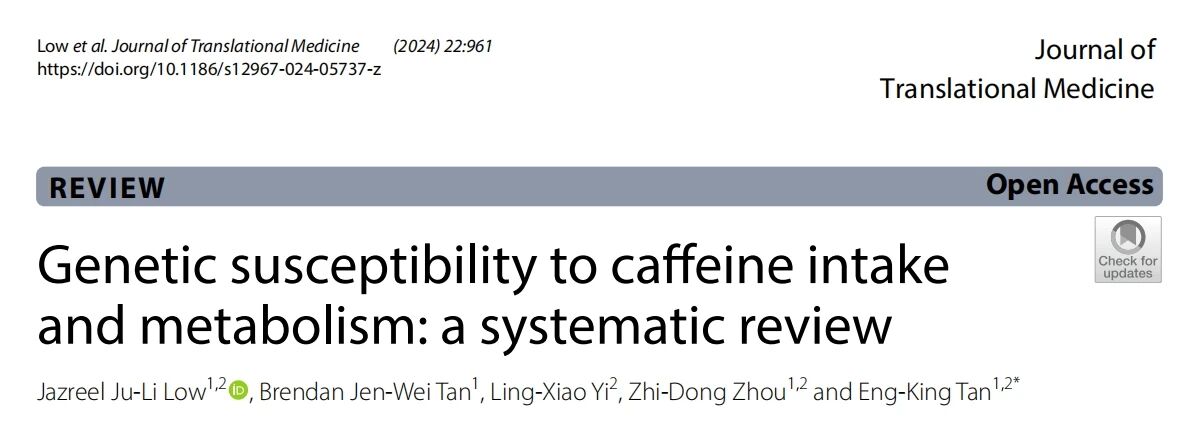
This is not the conclusion of one or two studies. It rests on:
● 2,552 papers screened
● 26 high-quality studies finally included
● 1.85 million people covered
Looking specifically at —
Why people respond so differently to caffeine.
In simple terms, close to one-third of your "habitual number of cups" is preset by your genes.
 How do genes "steer" your coffee choices?
The study found that two large gene families are quietly competing:
① The metabolic gene team (how long caffeine stays in your body)
● CYP1A2: the main force metabolizing caffeine in the liver; different variants significantly widen the gap in caffeine clearance speed
● AHR: the "switch" that regulates CYP1A2, determining whether your metabolic system runs efficiently
● ABCG2: the "gatekeeper" of the blood–brain barrier, controlling how much caffeine reaches your brain
② The reward gene team (how easily coffee gets its hooks into you)
● DRD2/DAT1: the core of the dopamine system, shaping the pleasure you get from coffee
● BDNF: brain-derived neurotrophic factor, which determines how sensitive your brain is to caffeine's "reward"
● SLC6A4: the serotonin transporter, which shapes how coffee affects your mood

What is even more striking:the effects of these genes are population-specific.
For example, a variant of the HECTD4 gene (rs2074356-A), found only in East Asian populations, is significantly associated with coffee consumption, while it is almost absent in European, African and American populations.
Exactly how specific is this genetic "steering"?
The study gives us quantitative data:each effect allele leads you to drink 3%–32% more caffeinated beverages per day.
Put another way:
● if you carry a "fast metabolizer" genotype (such as CYP1A2 rs762551-AA), you may drink an extra third of a cup every day without noticing;
● if you are a "high reward sensitivity" type (such as certain DRD2 variants), coffee brings stronger pleasure and you are more easily hooked.

But! Genes are only the script — your body is the director.
There is one key idea that needs updating: genetic testing can only tell you your "innate constitution," not your "current state."
It is like being handed a finished script (your genotype), while today's performance (your phenotype) still depends on:
● How well you slept last night (changes in liver metabolic capacity)
● How stressed you have been lately (fluctuations in neural sensitivity)
● Whether you are taking other medications (competition for metabolic pathways)
More importantly, genes only shape "how many cups," while "how your body reacts" is what really matters. Two people may have similar genotypes and both drink two cups, yet:
Person A: clear-headed and refreshed, with double the work efficiency
Person B: racing heart, anxiety and insomnia
Why? Because beyond genes, your current metabolic state and neural sensitivity are also at work together.
The "hidden cost" of caffeine:
more than just a sleepless night
The study also points to a seriously underestimated problem:caffeine dependence is becoming a global health concern.
Around 6%–14% of the population may meet the criteria for "caffeine use disorder." Long-term excessive intake may lead to:
● Withdrawal headaches, low mood and poor concentration
● Disrupted sleep architecture, creating a vicious cycle
● Increased cardiovascular risk in some populations
Especially for slow metabolizers, caffeine "lingers" longer, and the potential risks are greater.
How to live peacefully with coffee?
Now that we know the influence of genes, what should we do?
The limits of conventional advice
"No more than 400 mg of caffeine a day" and "nothing after 2 p.m." — generic advice like this falls short in the face of individual differences.
400 mg may be a reliable pick-me-up for a fast metabolizer, but a source of anxiety for a slow one.
A 2 p.m. cutoff may still leave some people counting sheep at 1 a.m.
Rather than agonizing over whether to drink or not, or struggling through the cycle of "insomnia if I drink, collapse if I don't," step outside the generic rules and truly understand yourself scientifically.
Now, with theMiMi™ · Caffeine Personality test, you can get a "user manual for coffee" written for your own body:
1 quantify your true metabolic rate
Leave behind the "theoretical value" inferred from genes. Built on NMR metabolomics, it directly assesses how efficiently your body is handling caffeine right now. Fast or slow — one test tells you.
2 measure your neural sensitivity
Is caffeine's effect on your brain a "gentle wake-up call" or a "full alarm"? We use scientific indicators to quantify the intensity of your neural response.
3 get your own "coffee navigation"
Based on the two core results above, MiMi™ generates a personalized plan you can act on immediately:
● Your safe upper limit:
It tells you clearly how many cups a day are "pleasant stimulation" and how many may become "excess burden."
● Your golden window:
It pinpoints the drinking window that gives the best boost during the day while least disturbing your sleep at night.
● Your smart alternatives:
When you need to cut back, it offers drink options that substitute perfectly in both taste and function.

Coffee is meant to be a help in life. Between a life-saving brew and a sleep stealer, there is in fact a "sweet spot" that belongs only to you.
That point is preset by your genes, but it is shaped even more by your body's state each day. Understand it, master it, and coffee will truly work for you rather than the other way around.
Share this with that friend who drinks coffee in the afternoon, cannot sleep at night, and still cannot quit. What they may need is not to "quit coffee," but to understand their own "caffeine personality" ❤️
For health advice, please consult a physician or a nutritionist. Coffee is good — just drink it knowingly!