
The same stage I disease, the same curative resection — so why do the outcomes diverge so sharply?
When medicine looks beyond the static pathology report and into the dynamic world of proteins, the fork in the road that was laid down long ago finally comes into view. This is no accident; it is a precise map drawn from the activity of 15 functional proteins — quantifiable and verifiable.

At the postoperative follow-up visit, patients with stage I lung cancer can look as though they are walking the same road to recovery. Real-world data, however, tell another story:
● Around 30% of stage I patients experience recurrence within five years. And by the time imaging finally picks up an abnormality, the median delay has already reached 11.2 months, often past the optimal window for intervention.
● A considerable number of patients at low risk of recurrence, lacking effective stratification tools, are still placed on intensive surveillance and treatment pathways, bearing medical and psychological burdens that could have been avoided.
"Why me?"
That question belongs not only to patients; it has long troubled clinicians too. And the answer has in fact been sealed away all along in that archived paraffin-embedded postoperative specimen.
1Where the roads divide: when staging falls silent, proteins start to speak
TNM staging is a precise anatomical map.
But it cannot answer a more critical question: of two seemingly identical points on that map, which one conceals dangerous currents beneath the surface, and which will remain calm for years?
This is precisely where PT-L1™ breaks through.
It no longer merely "reads the map"; it turns to monitoring tectonic activity — assessing directly whether the functional proteins that drive tumour recurrence are switched on.
A more intuitive analogy:
● Conventional methods:
Taking stock of soldiers and weapons (TNM staging, gene mutations).
● PT-L1™:
Listening to the radio traffic to see whether command is functioning, whether troops are assembling, and whether action has been triggered (the functional activity of proteins).
Powered by an LC-MS/MS platform, PT-L1™ delivers simultaneous, absolute quantification of 15 functional proteins, translating the activity levels of key functional dimensions of the tumour — proliferation, invasion, immune evasion and metabolic reprogramming — directly into numerical risk parameters for precise stratification of postoperative recurrence risk.
215 "signposts", two outcomes
Validated retrospectively in more than 700 patients with stage I lung cancer, PT-L1™ has built a stable predictive system:
1. Precision mapping: simultaneous, absolute quantification of 15 key proteins;
2. Intelligent interpretation: integrating multi-dimensional protein data through algorithms to generate a recurrence risk score (RS);
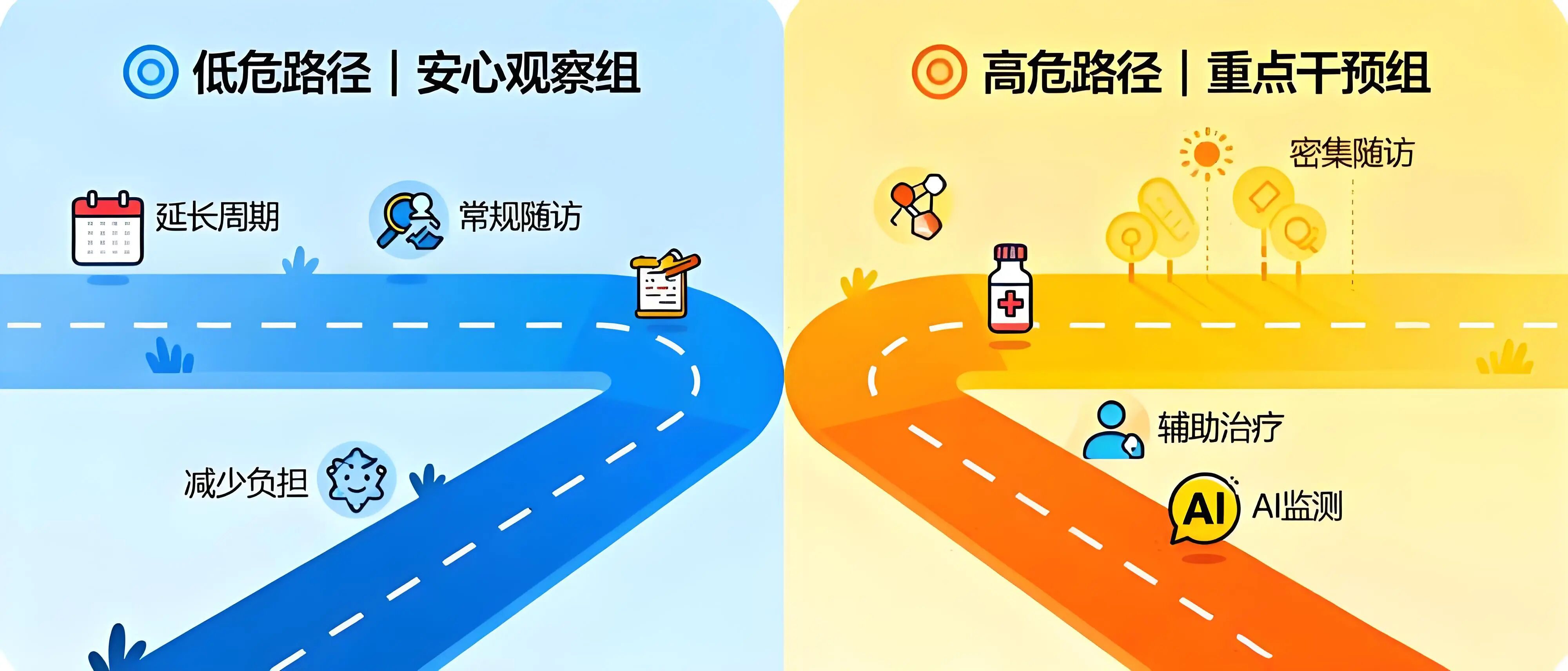
3. Clear classification: steering seemingly identical stage I patients onto different management paths.
● Consistent with the baseline of comparable patients:
Assigned to the "reassurance management group", where the strategy centres on "rationally lightening the load" — avoiding overtreatment and cutting unnecessary intensive follow-up.
● Above the baseline of comparable patients:
Placed in the "heightened-alert group", where the strategy shifts to "proactive early warning" — shortening follow-up intervals (e.g. 3-6 months) to capture the intervention window.
Worth particular attention: PT-L1™ is one of the few recurrence-risk prediction models validated for both adenocarcinoma and squamous cell carcinoma at stage I, reaching beyond conventional mRNA models, which are largely confined to adenocarcinoma, so that far more patients gain genuine access to precise stratification.
3A management leap: from "waiting months" to "known in 7 days"
What PT-L1™ brings is not simply an updated assay, but a restructuring of the logic of postoperative management.
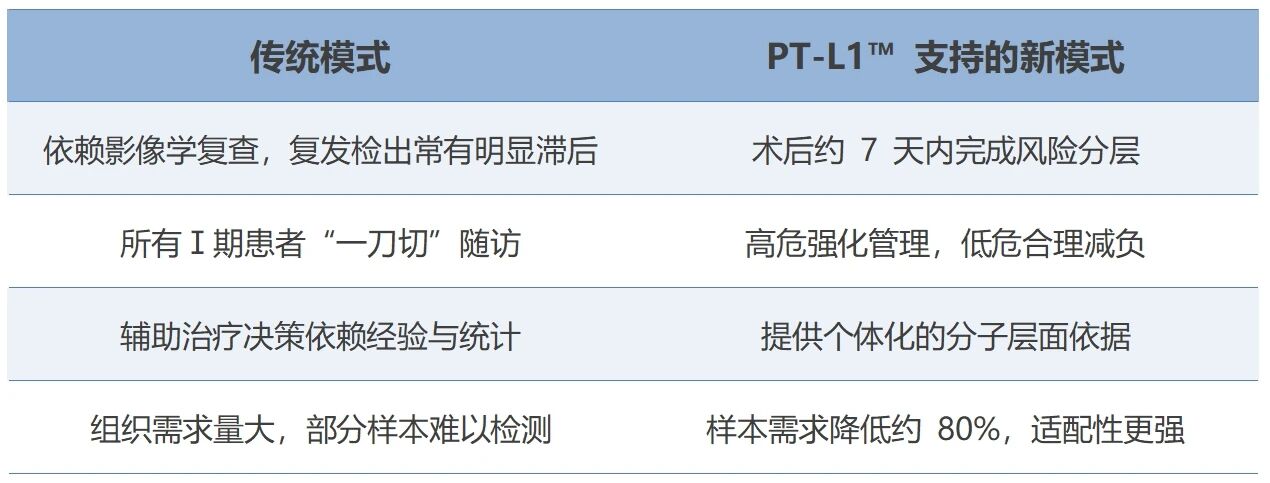
In the past, doctors and patients often had to endure a long spell of "watchful waiting". Now, with PT-L1™, risk can be positioned within one week of surgery and the management path for the next one to five years planned together — turning passive anxiety into active planning.
4Making a judgement of "low risk" genuinely trustworthy
In risk prediction, specificity matters above all — it is what determines whether a judgement of "low risk" can really be relied upon.
Multicentre studies show that PT-L1™ performs impressively:
● Specificity ≥95%
A highly reliable judgement of "low risk", substantially reducing misclassification and unnecessary intervention
● Sensitivity ≥54%
Provides early warning in the majority of high-risk patients, buying time for intervention
● Based on 700+ real cases
Solid data, with results independently validated
This means that when a doctor says "your risk is low", there is solid data standing behind those words.

The divergence of outcomes after surgery for early-stage lung cancer is no accident. It is pre-written by specific patterns in the tumour's protein function network. PT-L1™ is like throwing a powerful beam of protein-function insight onto a junction hidden in fog: through earlier (7 days) and more accurate (95% specificity) risk warning, it gives us a chance to influence the outcome — capturing the window for those who need intervention, and lifting the burden from those who can be reassured.
In this race against time with recurrence, PT-L1™ presses a valuable "early-warning accelerator". Because we see it sooner, we have a better chance to change it.
