
We often say that "age is just a number." Yet from the perspective of medicine and systems biology, what truly determines health status and disease risk is an individual'sbiological age.
A landmark study recently published in Nature Medicine has, for the first time, built a full-life-course biological clock model spanningfrom infancy to old age—LifeClock—based on ultra-large-scale electronic health records (EHR). The study makes it clear that the body's "time course" has long been hidden in routine check-up data.
▍ This means: an ordinary check-up you had at the age of 10 may already have hinted at your health trajectory at 50.
①
From "Chaotic Data" to "Digital Twin":
How AI Truly Reads Health
▼
Previous "biological clock" studies had obvious limitations:
● They focused mainly on adults and overlooked childhood development
● They relied on costly genomic or multi-omics technologies
● They were disconnected from everyday health management and hard to put into practice
The breakthrough of LifeClock, by contrast, rests on the most "ordinary"—and most accessible—kind of clinical data.
The research team integrated longitudinal data covering approximately 9.68 million people and 24.63 million clinical visits, including routine items such as blood counts, liver and kidney function and metabolic markers, and used them to train a time-series model designed specifically for medical data—EHRFormer.
It acts like a highly skilled "health interpreter," able to handle the problems commonly found in medical data:
● Data incompleteness:not every check-up includes every item
● Inconsistent standards:differences between hospitals and instruments
● Personalized trends:each person's bodily trajectory is unique
Unlike conventional approaches, EHRFormer is not concerned only with whether a single test result is abnormal; it focuses onthe direction in which your body is changing. In this way, the system builds for each person a continuously updated, multi-dimensional and dynamic "digital health twin"—another version of you inside the AI world.
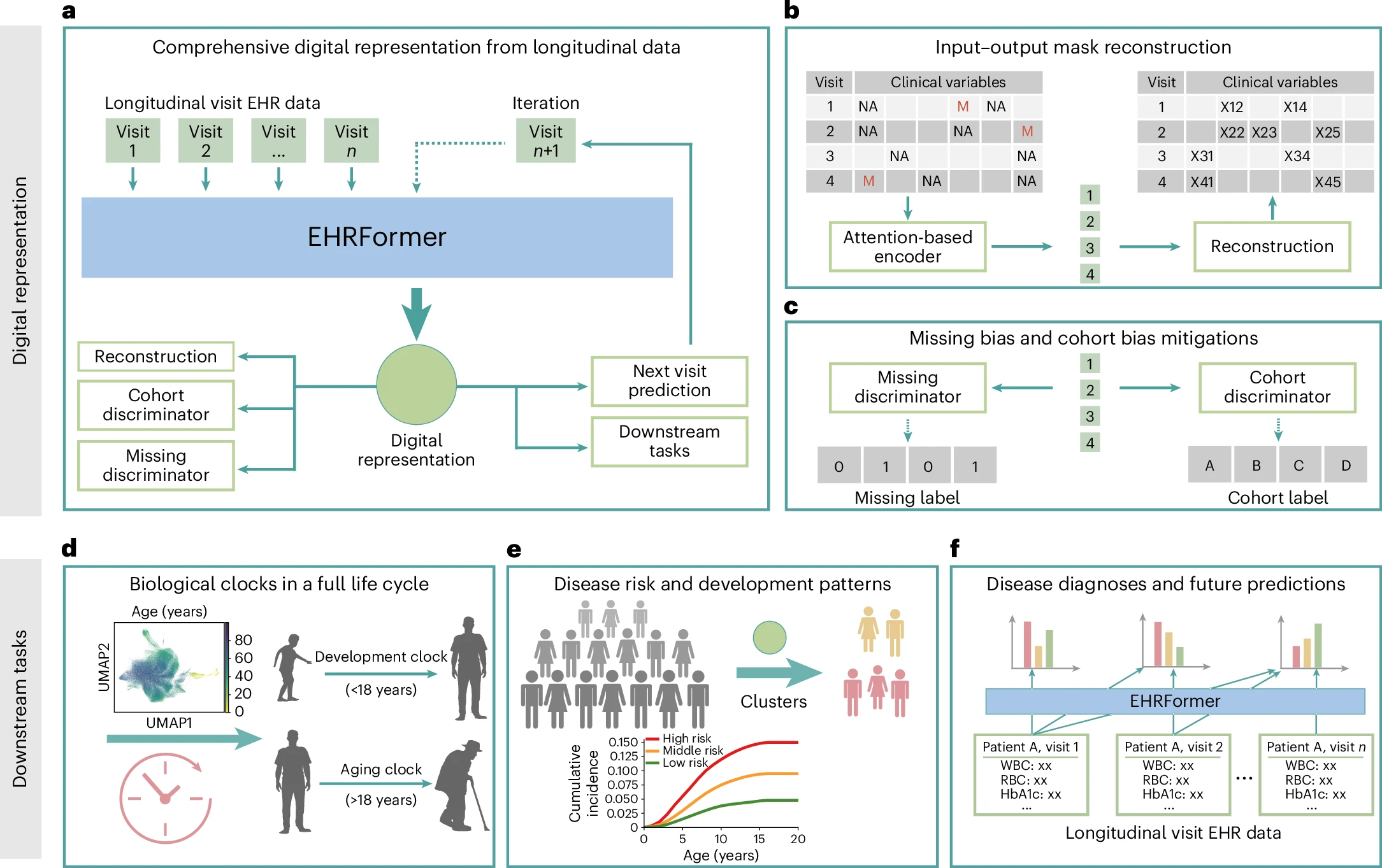
The architecture of EHRFormer and its application to longitudinal clinical data analysis
②
Life Runs on Two "Clocks":
Development and Aging Follow Completely Different Trajectories
▼
The study draws a clear distinction between two stages of life:
Childhood (<18 years): the development clock
Biological characteristics:growth and maturation
Key indicators:low aspartate aminotransferase, high creatinine, high total protein
Clinical value:predicting growth-related risks such as developmental delay, precocious puberty, malnutrition and obesity
Adulthood (>18 years): the aging clock
Biological characteristics:declining organ function
Key indicators:high urea, low albumin, high red blood cell distribution width
Clinical value:associated with the risk of diabetes, hypertension, coronary heart disease, stroke and renal failure
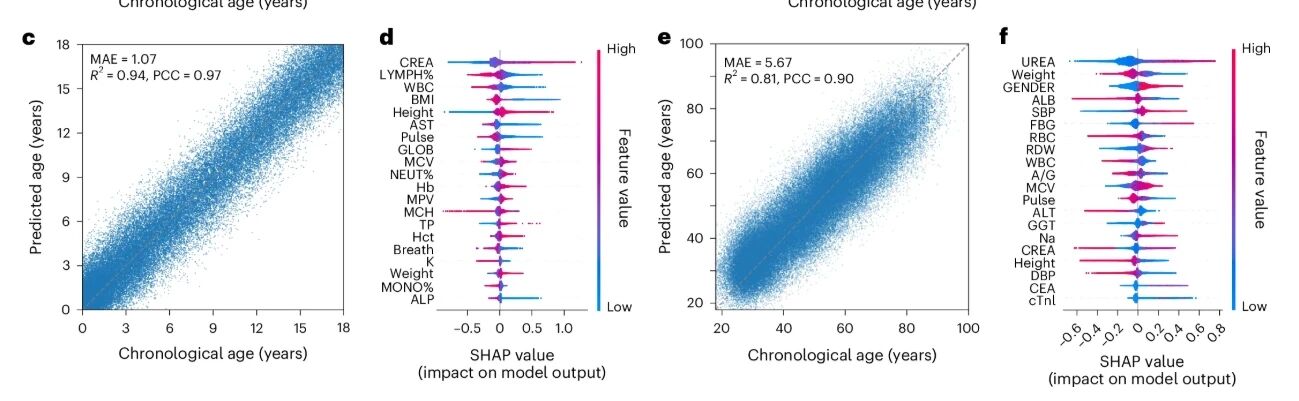
The full-life-course biological age (BA) prediction model and key characteristics of the childhood and adult stages
③
Seeing the Future: How AI Warns of Disease a Decade in Advance
▼
When the model was applied to disease risk prediction, the results were even more striking:
● Using only check-up data from before the age of 12, it can stratify the risk of adult obesity, asthma and epilepsy
● Based on data from around the age of 40,it can predict the likelihood of developing coronary heart disease, stroke, Parkinson's disease and other conditions
● Prediction accuracy (AUC) for multiple diseases reached 0.8–0.95 or higher
Even more noteworthy: people whose biological age is markedly older than their peers (more than three standard deviations above the mean) show a significantly higher incidence of disease in the future—
● Risk of renal failureup to 37.7 times higher
● Risk of hypotension9 times higher
● Risk of diabetesincreased 3.00–3.75 times
● Risk of cardiopulmonary diseasesignificantly associated with elevated cTnT, elevated blood potassium and reduced blood oxygen saturation
▍ This means: years, even decades, before symptoms appear, risk has already been written into the body's "trajectory of change."
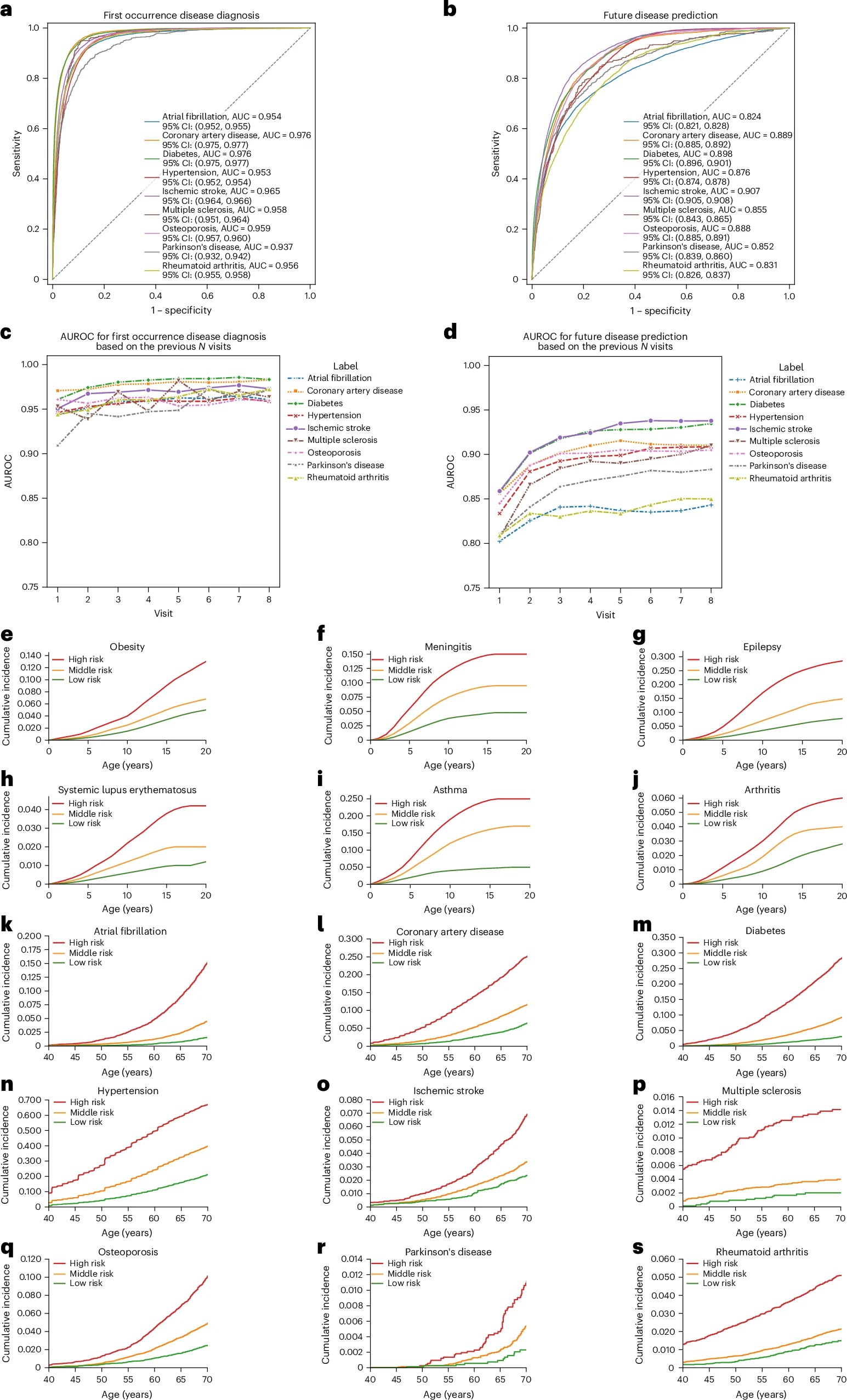
Performance of the EHRFormer-based disease prediction model in the CHAI-Internal cohort and cumulative risk analysis
④
A Paradigm Shift in the Health Industry:
From "Treating Established Disease" to "Managing Trends"
▼
This study is valuable not only medically; it also offers deeper inspiration for the health management industry:
A shift in the concept of health check-ups:
from "checking whether something is abnormal" to "assessing the rhythm of life"
An upgrade in the concept of anti-aging:
from "a vague idea" to "quantifiable indicators"
Reinventing chronic disease prevention and control:
from "treatment after onset" to "intervention ten years earlier"
Transformation of health management:
from "generic protocols" to "personalized pathways"
The most critical insight is this:
▍ We do not necessarily need to depend on expensive, high-end testing. A great deal of information about the course of life is already hidden in routine, accessible, low-cost check-up data.
⑤
If blood is recording the "trajectory of aging,"
then what is urine telling us?
▼
If blood can portray the rhythm of life, then does urine also hold a "biological clock" of its own?Might the urinary metabolites that reflect metabolism, inflammation and organ function be quietly recording the body's long-term trajectory of change?
Moving from "disease has already occurred" to "change is under way," and from extending lifespan to extending healthspan,is the central direction of precision health management in the years ahead.
Within this philosophy,the exploratory path of MiMi™ aligns closely with the logic of LifeClock.
MiMi™ is not a single-marker test. Through systematic analysis of the urinary metabolite profile, it assesses an individual's"MiMi biological age"and the metabolic and functional state behind it. This helps detect shifts in the body's rhythm earlier, capture potential risk signals before obvious decline sets in, and provide a scientific basis for diet, lifestyle and personalized intervention.
If LifeClock builds a "macro timeline of life" based on blood and longitudinal records, then what MiMi™ creates is a "micro biological age radar" that starts from urinary metabolism and focuses on the urinary and metabolic system dimensions.
This is the new approach to health management that MiMi™ hopes to help build.