
"The surgery was a success; the tumour was completely removed."
This sentence is the greatest comfort available to a patient with stage I non-small cell lung cancer after surgery, and it also builds, quietly, a "psychological safety barrier".
Yet cold clinical data reveal another fact:even after successful surgery, around 30% of stage I patients will still face recurrence.
1If the tests are normal, why does recurrence still happen?
Many stage I patients go through a reassuring routine at follow-up: the CT scan shows everything is normal, blood indicators sit comfortably within the reference range, and the body recovers a little more each day. Every sign tells you — "you should be fine now". And yet, six months or a year later, news of recurrence can arrive without the slightest warning, catching you completely off guard.
Behind this lie two hidden characteristics of stage I lung cancer recurrence:
● Early recurrence is "silent":the budding stage of a lesion is usually entirely symptom-free
● The "time lag" of imaging:tiny lesions are hard for imaging to capture before they reach a certain size
This means that"normal test results" do not equal "zero risk".
This is precisely the central limitation of the traditional follow-up model:
it can confirm a recurrence that has already happened, but it cannot see the risk that is still brewing.
2TNM staging: why can it not answer the question "who will relapse"?
"We are both stage I, so why are our outcomes different?" — this is the most heartbreaking question in the clinic.
The root cause is this:
TNM staging describes the tumour's "anatomical form", while recurrence risk depends on its "intrinsic biological behaviour". It can answer how big the tumour is and where it is, but it cannot reveal:
● How fast are the tumour cells proliferating?
● Does the tumour have the ability to escape the immune response?
● How aggressive is it potentially?
The answers to these key questions, which decide the fate of recurrence, are all encoded in the dynamic network of functional proteins — far beyond the reach of imaging.
3The root of recurrence: a "biological propensity", not what the eye can see
A large body of real-world research points to the same conclusion:
the seeds of recurrence are planted deep in the functional abnormalities of the tumour, and cannot be fully revealed by imaging or by genetic variation alone.
These abnormalities include:
● aberrant activation of cell proliferation and invasion pathways
● remodelling of the tumour microenvironment
● enhanced immune escape capability
● global dysregulation of the protein regulatory network
These changes occur at the level of protein function and can be regarded as the "starter switch" of recurrence; they switch on long before any imaging abnormality appears.
Many "sudden" recurrences in stage I patients have in fact been foreshadowed for a long time — conventional detection methods simply cannot see them.
4Conventional follow-up: two insurmountable blind spots
Blind spot one: all stage I patients are treated "the same"
Uniform follow-up intervals, identical examination protocols.
Yet the real recurrence risks are completely different:
some people remain safe and well for five years, while others relapse within six months.
Blind spot two: recurrence can only be found "after the fact"
By the time imaging picks up an abnormality, recurrence is already a fact.
At that point it usually means:
the tiny lesion has finished proliferating, and the best window for intervention has already been missed.
This is the most regrettable part for those 30% of patients who relapse: defences could have been set up earlier, but instead they can only fight a reactive battle.
5A paradigm shift: from "waiting for recurrence" to "predicting risk"
Looking back over a decade of lung cancer management, we are moving through three stages of evolution:
● looking at "form" → TNM staging
● looking at "change" → imaging and dynamic ctDNA monitoring
● looking at "essence" → functional proteomics
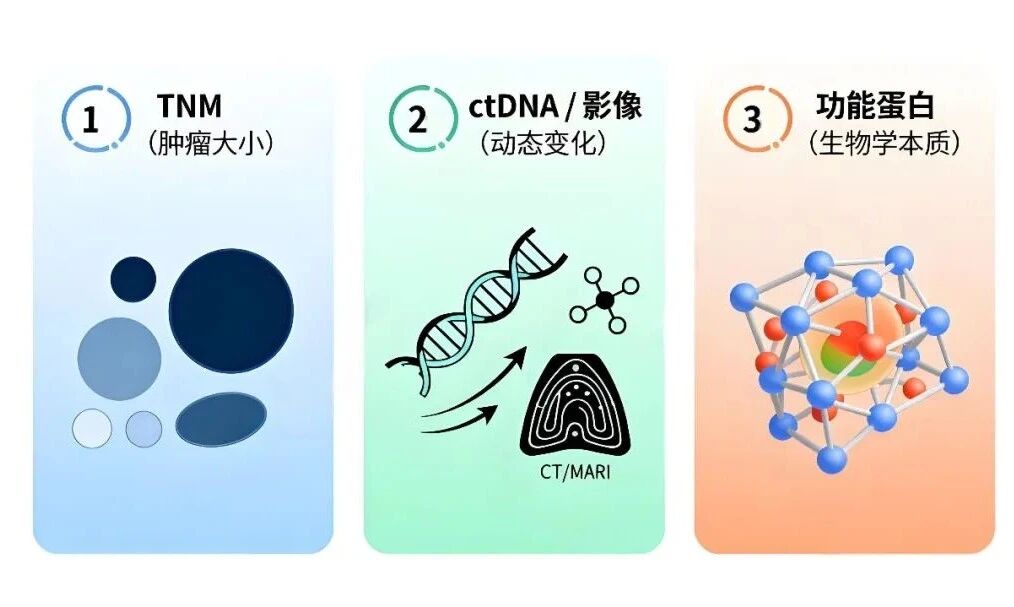
What makes the third stage revolutionary is this:
it no longer looks for a recurrence that has already occurred; it predicts who will relapse.
Functional proteomics can capture the core biological processes that drive recurrence directly:
● growth signals
● invasive capacity
● immune escape
● metabolic reprogramming
● microenvironment interaction
The earlier this information is obtained, the more critical the basis it provides for clinical decisions:
Who needs more intensive follow-up?
Who is genuinely low-risk and can be spared excessive testing?
Who should receive active intervention as early as possible?
This marks the entry of post-operative management for stage I lung cancer into a new era of "predictive intervention".
▍ The recurrence blind spot is not a low-probability event; it is a systemic problem that urgently needs solving.
Stage I surgery does not mean "safe for life".
Where conventional tools struggle to capture recurrence risk,
a more precise prediction system will become the key to lung cancer management over the next five years.
And functional proteomics is currently one of the most promising directions internationally.
