
If data is the "oil" of the new era, then the algorithms and computing power that turn data into insight are the "engine" driving the entire industry forward.
In the life sciences, this race for "foundational computing power" has quietly begun. What it determines is not only the speed of research, but the landscape of life science innovation over the next decade.
Part.1 From "model" to "matrix":the systemic leap of research intelligence 
Elixir™ is not merely an AI model; it is a"model matrix" that can be rapidly adapted to multi-center, multi-task and multi-modal data. In its core logic, research is no longer an isolated "point," but a continuously expandable intelligent matrix.
On top of this foundation, we have built a systematic task map for molecular omics, covering the complete research pathway fromprediction and characterization to multi-modal fusion, providing the life sciences with a genuine "system-level intelligence engine."
A Prediction tasks (supervised learning)
Full-cycle risk insight, from diagnosis to prognosis
01
Classification models (diagnosis / screening / subtyping)
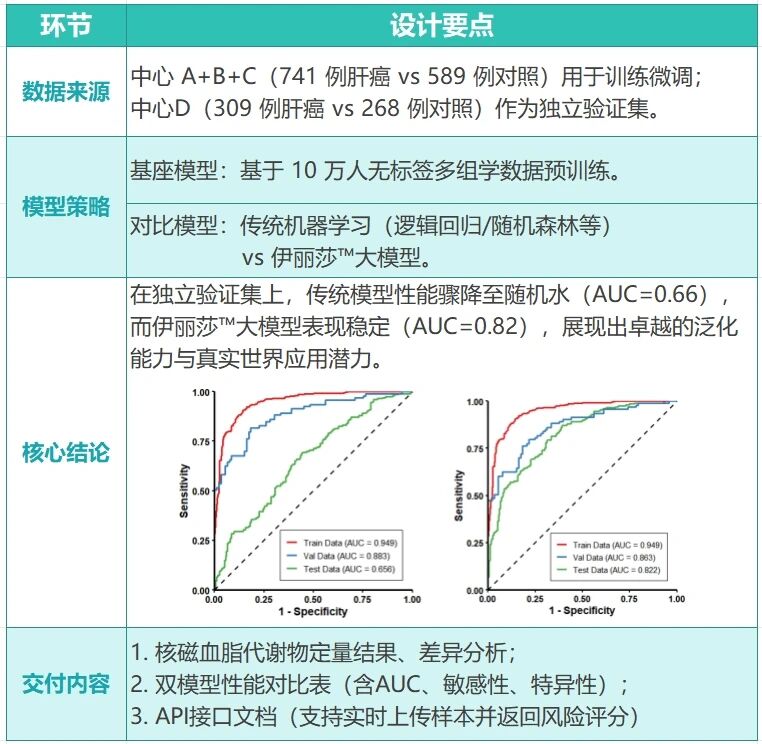
Case:a comparative study of liver cancer risk prediction models based on multi-center data (liver cancer patients vs. non-liver-cancer samples), in which deep learning achieved high-precision classification on metabolomics data.
Deliverables:performance reports (AUC, sensitivity, specificity), risk scores, quantitative results, differential analysis and API access.
02
Regression models (quantification of continuous indicators)
Case:using NMR metabolic profiles to accurately predict key physiological indicators such as blood urea nitrogen, and to assess liver and kidney function, metabolic age and inflammatory markers.
Deliverables:performance reports (R², RMSE/MAE), quantitative results, correlation analysis and API access.
03
Prognosis and survival analysis (time-to-event)
Case:going beyond conventional TNM staging to build individualized prediction models for recurrence-free survival (RFS) and overall survival (OS), providing a basis for treatment decisions.
Deliverables:performance metrics (C-index, time-dependent AUC), stratified survival curves, risk thresholds and follow-up recommendations, and API access.
B Characterization and stratification tasks (unsupervised / self-supervised)
Discovering unknown disease subtypes
Case:through unsupervised clustering, fragmented patient data is integrated into "life signatures" that reflect underlying metabolic patterns, enabling precise patient stratification.
Deliverables:subgroup stability indices, and analysis of differences in clinical features and prognosis.
C Multi-modal fusion tasks
Achieving the "1+1>2" leap in precision
Case:fusing NMR, mass spectrometry, protein and clinical data to significantly improve the quantitative accuracy and predictive robustness of models.
Deliverables:fusion pipelines, modality contribution analysis, performance gain reports and API access.
▍ Powered by the attention mechanism of the Transformer architecture, Elixir™ can efficiently fuse multi-modal data, adapt quickly to new tasks with only a few samples, and has demonstrated excellent robustness in multi-center validation—providing support that is "comprehensive, fast and stable" for the last mile from research to application.

Part.2 A real-world case: a comparative study of multi-center liver cancer risk prediction models
Part.3 Ecosystem vision: becoming the "basic operating system" of the life sciences
Elixir™ aims not merely to provide models, but to build an open platform that supports innovation across the industry.
● Layer one: AI infrastructure (IaS)
A pre-trained, continuously evolving large-model foundation—the "kernel" of the entire ecosystem.
● Layer two: the model application ecosystem (MaS)
Partners can develop, list and commercialize their own disease models on top of the foundation.
● Layer three: industry solutions (SaS)
Connecting diagnostics, pharmaceutical companies, insurers and health management platforms,
to open up a full-chain innovation loop spanning "screening—diagnosis—treatment—monitoring."
Who controls the foundational computing power of next-generation life science?
▍ The answer belongs to those who can bring together top-tier data, algorithms and industry collaboration,
▍ and who can turn research intelligence into universally accessible value.
▍ Elixir™ is moving decisively toward that goal.
The blueprint has been drawn and the path is clear. We will officially launch the "Elixir™ Large Model Foundation Partnership Program", built on the principles of openness, co-creation and shared success, and extend an exclusive pioneer invitation to industry partners.
