

Alzheimer's disease does not suddenly begin on the day someone "starts forgetting things." By 2025–2026, AD blood biomarker research is no longer only comparing accuracy in papers: the first blood-based adjunct diagnostic test received FDA clearance for marketing in the United States, professional guidelines began proposing clear performance thresholds, and automated platforms, community cohorts, and Chinese population data have been accumulating rapidly. Blood testing is moving from "can it be measured" toward "who should be tested, how to interpret it, and how it enters the diagnostic workflow."
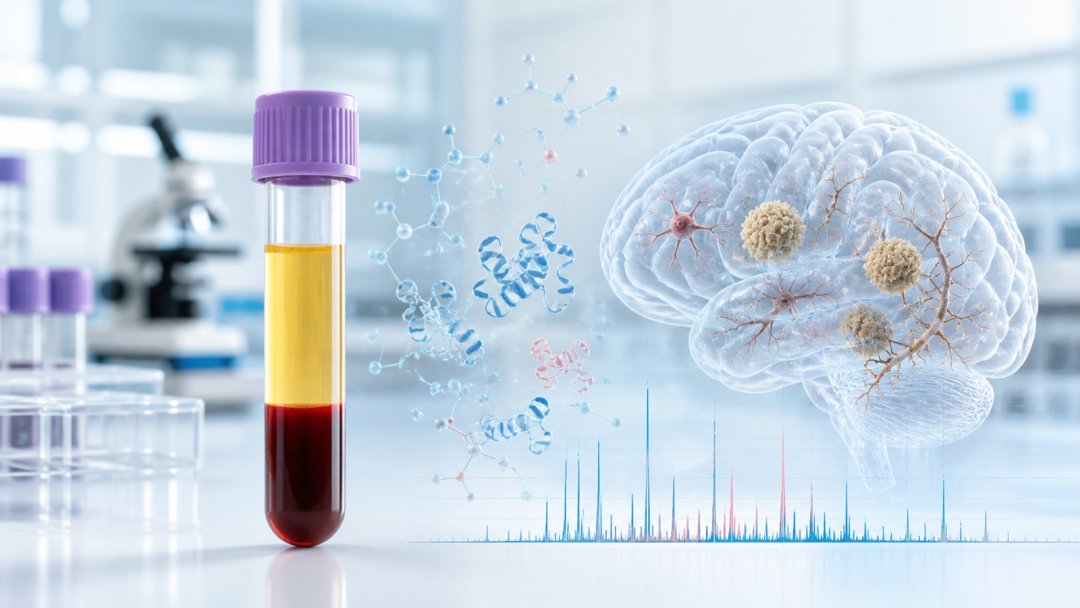
Memory decline is often not the starting point of change
Many people's understanding of Alzheimer's disease (AD) begins with repeated forgetfulness, slowed speech, or declining daily functioning. But from a pathological perspective, these symptoms are often the result of changes accumulated over many years.
The two core pathological features of AD are amyloid deposition and abnormal Tau protein aggregation in the brain. This may subsequently involve axonal injury, glial cell responses, brain structure changes, and cognitive decline. These changes do not occur at the same time, but unfold like a gradually expanding timeline.
This also explains why early identification is so difficult: by the time symptoms are obvious, the disease-related biological processes may have been ongoing for years; and in the absence of obvious symptoms, daily performance alone makes it hard to tell what is happening in the brain.
The value of body fluid biomarkers lies in converting these invisible changes into molecular signals that can be measured, compared, and followed up.
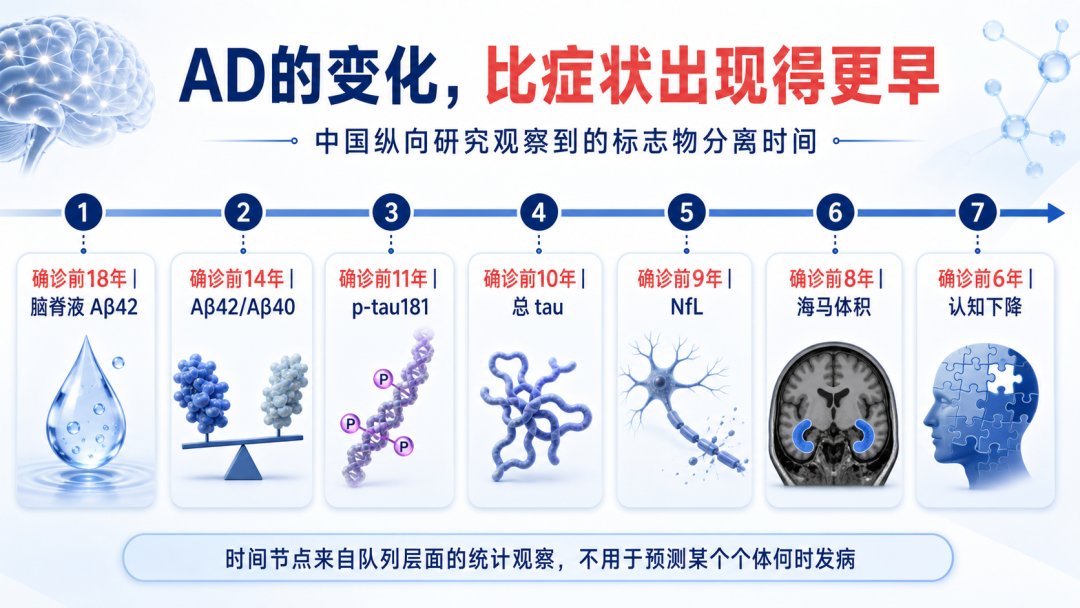
AD changes on a gradually unfolding timeline
In 2024, Professor Jia Jianping's team published results from the China Cognition and Aging Study in the New England Journal of Medicine. The study used a multicenter nested case-control design, pairing 648 participants later diagnosed with AD with 648 participants who remained cognitively normal, and retrospectively observed biomarker changes over the 20 years before diagnosis.
The study showed that, compared with the cognitively normal group, cerebrospinal fluid Aβ42 in the AD group diverged as early as 18 years before diagnosis; subsequently, differences were observed in Aβ42/Aβ40, p-tau181, total Tau, neurofilament light chain (NfL), hippocampal volume, and cognitive ability.
Here, "18 years before diagnosis" does not mean that a single test can predict that a person will develop the disease 18 years later. It describes the average statistical trajectory at the cohort level: before clinical diagnosis, disease-related molecular changes may have existed for a considerable time.
For research and clinical translation, this timeline offers two important insights: first, early screening cannot wait only for symptoms to appear; second, the biomarkers worth attention may differ at different stages.
Why is blood becoming an important "molecular window"?
At present, AD pathological evidence mainly comes from positron emission tomography (PET), cerebrospinal fluid testing, and blood biomarkers. The three observe interrelated targets, but their use scenarios are not entirely the same.
PET can directly observe amyloid or Tau burden in the brain, but equipment requirements and costs are high; cerebrospinal fluid biomarkers are closely related to central pathology, but require lumbar puncture; blood sampling is more convenient, repeatable, and better suited to large-scale research and long-term follow-up.
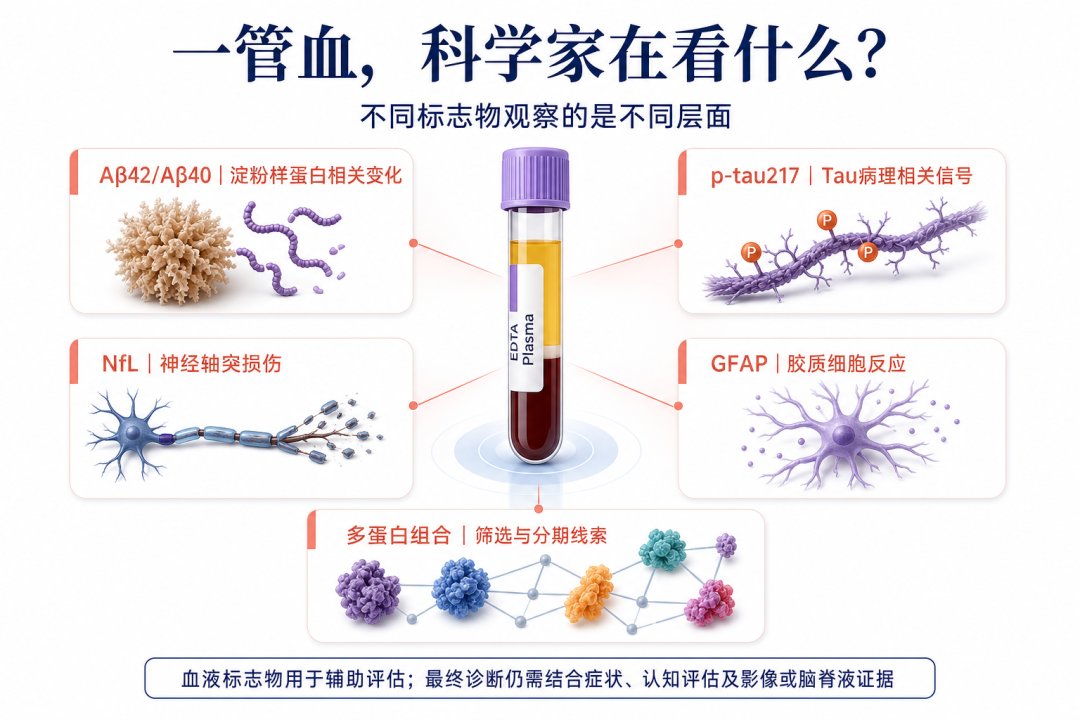
Common AD-related research indicators in blood include:
1. Aβ42/Aβ40: reflects amyloid-related changes, but has high requirements for detection precision and preprocessing.
2. Phosphorylated Tau such as p-tau217: strongly associated with AD-related amyloid and Tau pathology, and one of the most intensively studied blood biomarkers in recent years.
3. NfL: reflects axonal injury, but is not AD-specific and may also be elevated in other neurological diseases.
4. GFAP: related to astrocyte responses and can provide supplementary information on neuroinflammation and pathological progression.
5. Multi-protein panels: seeking complementary signals from a broader protein expression network, used for candidate biomarker discovery, risk stratification, and disease staging research.
In other words, blood testing is not about finding a single "AD protein." Different biomarkers observe different biological layers, and only by placing them together is it more likely to reconstruct the disease process.
Focus on one protein, or a panel of proteins?
AD blood biomarker research broadly follows two technical routes.
One is "targeted detection": building high-sensitivity methods and validating clinical thresholds around known biomarkers such as p-tau217 and Aβ42/Aβ40. A 2024 Nature Medicine study in the Swedish BioFINDER-2 cohort (1,422 people) and the U.S. Knight ADRC cohort (337 people) showed that mass-spectrometry-measured plasma %p-tau217 performed comparably to clinical cerebrospinal fluid testing in discriminating Aβ PET status, and also performed well in Tau PET status classification.
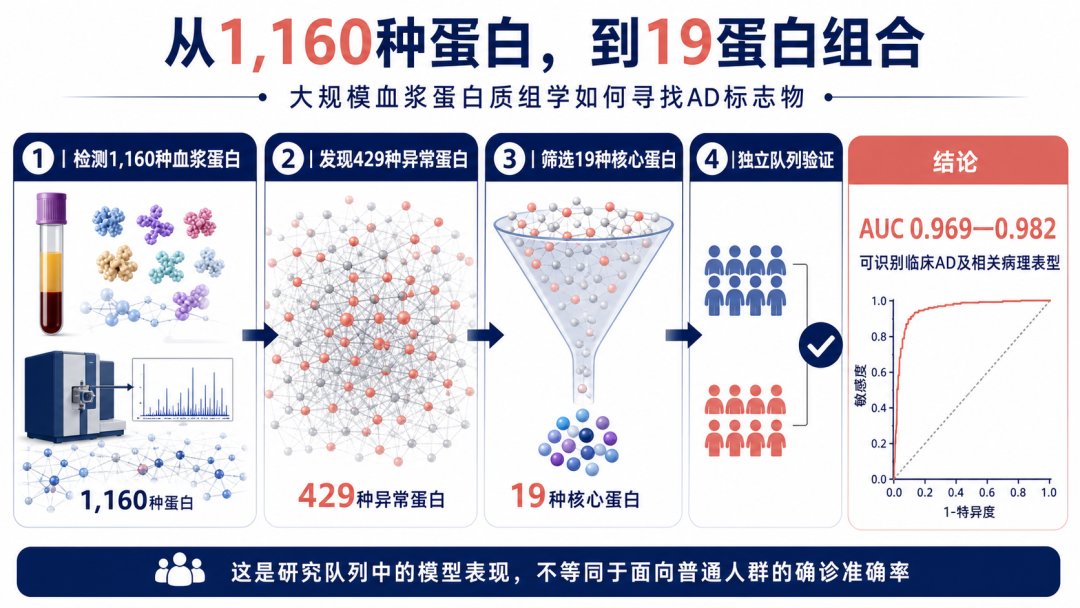
The other is "discovery proteomics": observing more proteins at once and screening new candidate panels from disease-related networks. Academician Nancy Ip's team systematically analyzed 1,160 plasma proteins, found 429 abnormal proteins, and screened out 19 core proteins. This panel achieved an AUC of 0.969–0.982 for clinical AD and related pathological phenotypes in the study cohort, and showed value for staging research.
These two routes are not mutually exclusive. Discovery proteomics is responsible for "broadening the view and finding candidates," while targeted methods are responsible for "improving reproducibility and establishing thresholds." For a candidate biomarker to truly move toward application, it usually needs to go from broad discovery to independent validation, and then to standardized targeted detection and prospective clinical evaluation.
2025–2026: what new stage have blood biomarkers entered?
Over the past year or so, the most obvious change in the AD blood biomarker field is that the research focus has begun to shift from "how accurate is a given indicator" to "can it be used stably in real diagnostic workflows."
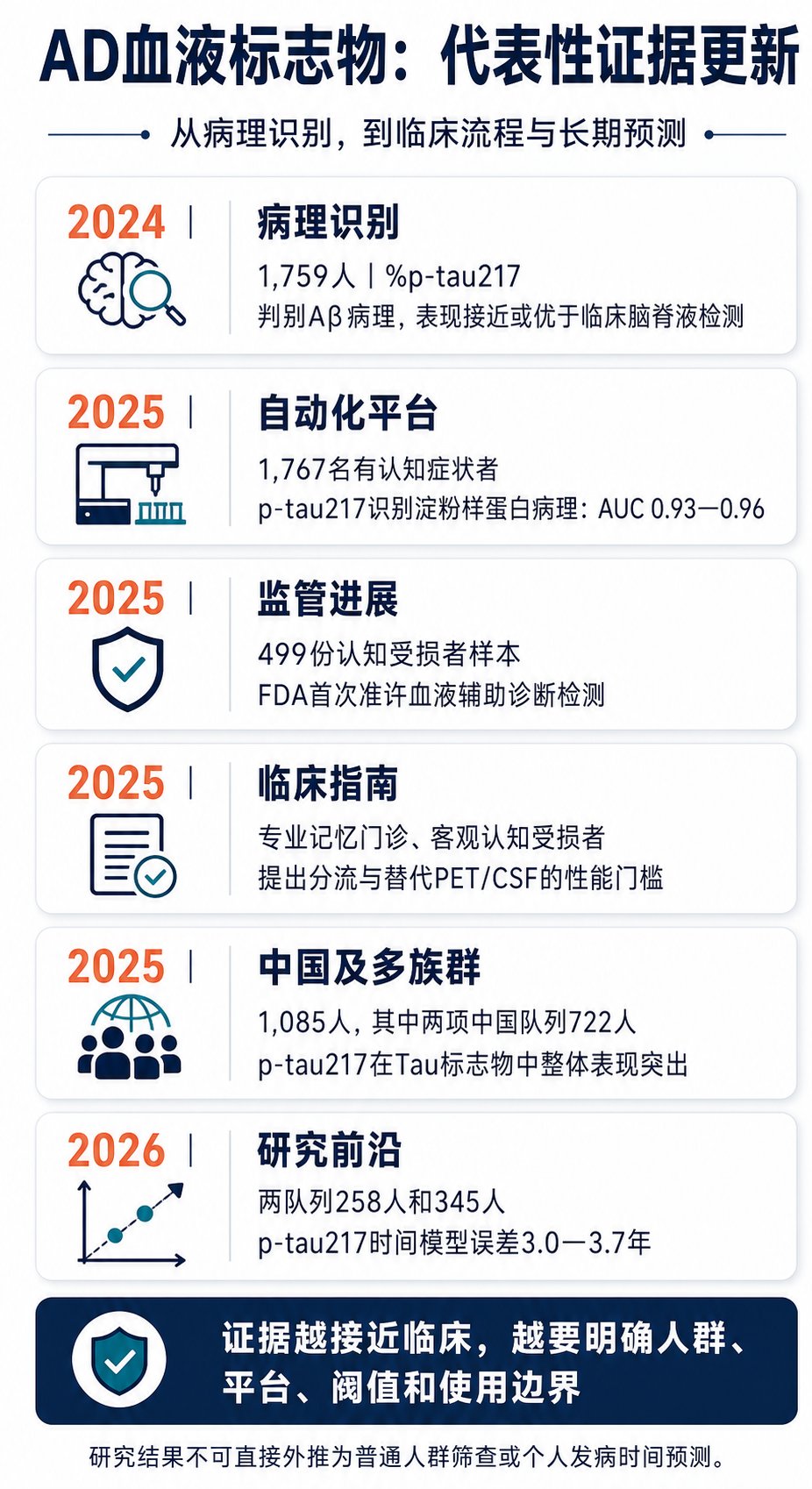
In April 2025, Nature Medicine published a study covering five independent cohorts with a total of 1,767 participants with cognitive symptoms, of whom 1,219 came from specialty care settings and 548 from primary care settings. A fully automated platform measuring plasma p-tau217 achieved an AUC of 0.93–0.96 in identifying amyloid pathology. The study also suggested that, across different care settings and population characteristics, a "negative threshold + positive threshold" dual-threshold strategy may be more robust than a single threshold.
In May 2025, the U.S. FDA cleared the first blood-based in vitro diagnostic test for AD diagnostic evaluation. The test measures the ratio of plasma p-tau217 to Aβ1-42, and is intended for people aged 55 and older who already have AD-related cognitive symptoms and are being evaluated in a professional medical setting. Among 499 samples from cognitively impaired individuals, positive results agreed with PET or cerebrospinal fluid evidence in 91.7% of cases, negative results in 97.3%, and fewer than 20% of results fell in the indeterminate range.
This is an important regulatory advance, but it does not mean "ordinary people can screen for AD with a blood draw." The FDA explicitly stated that this test is not a screening tool and cannot be used alone for diagnosis; results must be interpreted together with clinical information; and this clearance decision addresses U.S. regulation and a specific product, and cannot be directly equated with approval status in other countries or for other testing platforms.
In July 2025, the Alzheimer's Association released a clinical practice guideline on blood biomarkers, limiting the applicable setting to people in professional memory clinics who already have objective cognitive impairment and suspected AD etiology. The guideline proposed that tests with sensitivity of at least 90% and specificity of at least 75% can serve as triage tools; tests with both sensitivity and specificity of at least 90% may, under specific conditions, replace Aβ PET or cerebrospinal fluid AD biomarker testing. However, these are conditional recommendations with still low certainty of evidence, and the performance data of many commercial tests await independent validation.
Chinese and multi-ethnic data are also increasing. A 2025 multicenter study published in Nature Aging included 1,085 people, of whom 722 were from the Greater Bay Area Healthy Aging Brain Study and the Huashan cohort. Comparing multiple plasma Tau biomarkers, the study found that p-tau217 performed prominently overall in identifying Aβ PET and Tau PET positivity and in tracking disease-related changes, again showing the importance of "dual thresholds" and longitudinal follow-up.
At the same time, the boundary of general community screening remains clear. Another 2025 Nature Medicine study followed 2,148 older adults without dementia at baseline for up to 16 years. Multiple blood biomarkers had a negative predictive value of over 90% for future dementia, but positive predictive value remained limited; even combining p-tau217, NfL, or GFAP, a positive result in the community cannot be directly taken as a certainty of future disease.
By 2026, research has begun to explore the "time" question. Two cohort studies, with 258 and 345 participants respectively, used longitudinal plasma %p-tau217 to build time models, estimating the median absolute error of symptom onset age in specific study populations at about 3.0–3.7 years. This suggests blood biomarkers may be used for clinical trial stratification and study design, but the authors explicitly do not recommend using them as a routine personal prediction tool for cognitively asymptomatic individuals.

Do these numbers mean blood testing can already "diagnose" AD?
The answer needs to be more accurately divided by scenario: some high-performance blood tests have entered regulated clinical adjunct diagnostic workflows, but this does not mean all blood biomarkers can "diagnose AD," still less that they are suitable for self-testing and screening in the general population.
First, the study populations differ. Some studies mainly enrolled patients with mild cognitive impairment or mild dementia, and results cannot be directly extrapolated to asymptomatic general populations.
Second, the detection methods differ. Even if all are called p-tau217, the molecular forms, units, thresholds, and quality control measured by different platforms may differ, and results cannot be simply interchanged.
Third, "AD pathology positive" and "already having AD clinical syndrome" are not the same thing. A biomarker suggests the possible presence of related pathology in the brain, but the final diagnosis still requires combining symptoms, cognitive assessment, medical history, imaging, or cerebrospinal fluid evidence, and comprehensive judgment by a professional physician.
Therefore, a more accurate statement is: for people who already have objective cognitive impairment and are being evaluated in a professional medical setting, blood tests meeting clear performance standards can play a triage role; a few tests, under specific regulatory and clinical conditions, may even replace some PET or cerebrospinal fluid examinations. But for asymptomatic ordinary people, it is still not appropriate to treat a single blood result as a screening conclusion, let alone to "stamp" a diagnosis detached from a complete clinical evaluation.
From biomarker research to product, what steps must be completed?
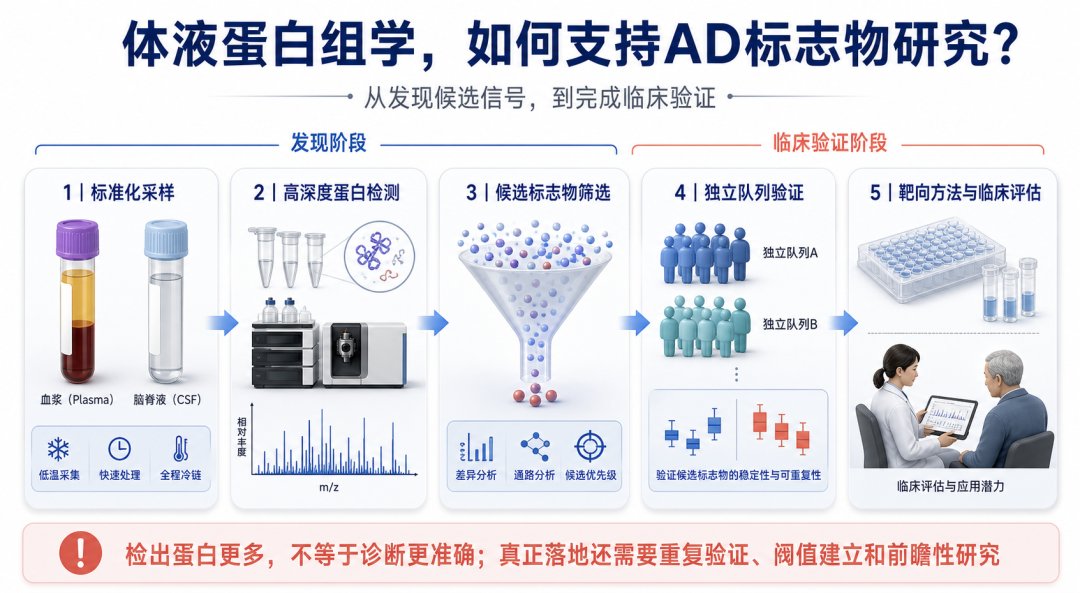
A high-quality biomarker study cannot stop at "finding a differential protein." From candidate signal to reliable tool, it must go through at least five stages: standardized sampling, high-depth detection, statistical screening, independent cohort validation, and targeted methods and clinical performance evaluation.
If any step is unstable, results that look promising may fail in a new cohort. For example, blood collection tube type, processing time, freeze-thaw cycles, and storage conditions can all change the body fluid protein profile; age, sex, kidney function, inflammatory status, and concomitant medication may also cause confounding.
A study with true translational value needs to clarify at the design stage the applicable population, control setting, sample preprocessing, batch control, and validation pathway, rather than seeking explanations after the data come out.
What kind of research support can ProteinT provide?
Focusing on body fluid low-abundance protein research and candidate biomarker discovery, ProteinT has established a proteomics technical chain from sample processing, mass spectrometry detection, and quality control to data analysis, and can be applied to research projects on plasma, serum, urine, cerebrospinal fluid, and other samples.
The n-LAPE/MS™ platform combines nanoscale low-abundance protein enrichment with mass spectrometry analysis, helping researchers expand the observation range of body fluid proteins. Under the specific conditions corresponding to existing technical materials — such as more than 200 μL plasma and long-gradient mass spectrometry — 6000+ proteins can be detected; actual results are affected by sample quality, preprocessing protocol, instrument method, and project design, and should be based on project quality control data.
It should be particularly noted that "detecting more proteins" does not equal "more accurate diagnosis." The core value of high-depth detection is to provide a richer data foundation for candidate biomarker discovery, pathway analysis, and mechanism research; whether it can form a diagnostic or stratification tool still requires validation through independent cohorts, targeted methods, and clinical research.
In AD research, such a platform can support:
1. Discovering new candidate proteins and protein panels from plasma or cerebrospinal fluid;
2. Comparing protein changes across cognitively normal, mild cognitive impairment, and different AD stages;
3. Observing molecular responses before and after drug intervention, seeking efficacy or safety biomarkers;
4. Combining with NMR metabolomics, genomics, and clinical phenotypes to build multi-omics interpretation models.
Five common questions about AD body fluid biomarkers
Q1: Can blood testing predict when a person will develop AD?
Currently, a single blood draw cannot be understood as a personal "onset countdown." In 2026, studies have used longitudinal %p-tau217 to build time models, estimating the median absolute error of symptom onset age at about 3.0–3.7 years in two specific cohorts, but this remains exploration at the research and clinical trial level and is not suitable as routine personal prediction for asymptomatic individuals.
Q2: Is p-tau217 currently the most noteworthy blood indicator?
p-tau217 is one of the AD blood biomarkers with stronger current evidence, but detection performance depends on the specific platform, threshold, and applicable population. Clinical use still requires combining other examinations, and a single value cannot be relied on alone.
Q3: Is a multi-protein panel necessarily better than a single biomarker?
Not necessarily. A multi-protein panel may capture broader biological information, but is also more prone to overfitting. Whether it is better depends on independent cohort validation, reproducibility, clinical gain, and detection cost, and cannot be judged only by comparing training-set AUC.
Q4: Can research-grade body fluid proteomics be used directly as clinical diagnosis?
No. Research-grade proteomics is used to discover and validate candidate signals; clinical diagnosis requires standardized methods, defined thresholds, performance validation, and corresponding regulatory processes. The two belong to different stages in a continuous translational chain.
Q5: An FDA blood test has been cleared for marketing — can ordinary people go directly to screening?
It cannot be understood this way. The test cleared by the FDA in 2025 is intended for people aged 55 and older who already have related cognitive symptoms and are being evaluated in a professional medical setting, and is explicitly not for general population screening or standalone diagnosis. The regulatory status of different countries, products, and platforms cannot be substituted for one another.
Closing thoughts
Alzheimer's blood biomarkers are undergoing an important leap: from proving "there is a signal in the blood" toward regulated products, professional guidelines, automated testing, and validation in real diagnostic settings. At the same time, Chinese population and multi-ethnic studies are filling in external validity evidence.
But the closer it gets to practical application, the more its boundaries must be respected. Auxiliary diagnosis in professional memory clinics is not the same as general population screening; a cohort-level time model is not the same as a personal onset countdown; and the threshold of one platform cannot be copied to another method. Body fluid proteomics can expand the discovery range of candidate signals, but still must undergo independent validation, standardized targeted detection, and clinical translation.
Truly valuable early identification is not about simplifying a complex disease into a single number, but about gradually connecting molecular evidence, clinical presentation, and long-term follow-up.
Scientific statement: This article is intended for health science popularization and research information exchange and does not constitute disease diagnosis, treatment advice, or individualized medical conclusions. If memory decline or cognitive changes occur, seek timely care at a qualified medical institution.
References
1. Jia J, Ning Y, Chen M, et al. Biomarker Changes during 20 Years Preceding Alzheimer's Disease. N Engl J Med. 2024;390:712-722. DOI: 10.1056/NEJMoa2310168.
2. Jiang Y, Zhou X, Ip FC, et al. Large-scale plasma proteomic profiling identifies a high-performance biomarker panel for Alzheimer's disease screening and staging. Alzheimer's & Dementia. 2022;18(1):88-102.
3. Ashton NJ, Brum WS, Di Molfetta G, et al. Diagnostic Accuracy of a Plasma Phosphorylated Tau 217 Immunoassay for Alzheimer Disease Pathology. JAMA Neurol. 2024;81(3):255-263.
4. Barthélemy NR, Salvadó G, Schindler SE, et al. Highly accurate blood test for Alzheimer's disease is similar or superior to clinical cerebrospinal fluid tests. Nat Med. 2024;30:1085-1095.
5. Palmqvist S, Warmenhoven N, Anastasi F, et al. Plasma phospho-tau217 for Alzheimer's disease diagnosis in primary and secondary care using a fully automated platform. Nat Med. 2025;31:2036-2046.
6. U.S. Food and Drug Administration. FDA Clears First Blood Test Used in Diagnosing Alzheimer's Disease. 2025-05-16. 510(k): K242706.
7. Palmqvist S, Whitson HE, Allen LA, et al. Alzheimer's Association Clinical Practice Guideline on the use of blood-based biomarkers in the diagnostic workup of suspected Alzheimer's disease. Alzheimers Dement. 2025.
8. Lan G, Wang M, Gonzalez-Ortiz F, et al. Comprehensive evaluation of plasma tau biomarkers for detecting and monitoring Alzheimer's disease in a multicenter and multiethnic aging population. Nat Aging. 2025.
9. Grande G, Valletta M, Rizzuto D, et al. Blood-based biomarkers of Alzheimer's disease and incident dementia in the community. Nat Med. 2025;31:2027-2035.
10. Petersen KK, Milà-Alomà M, Li Y, et al. Predicting onset of symptomatic Alzheimer's disease with plasma p-tau217 clocks. Nat Med. 2026;32:1085-1094.
ProteinT is a national high-tech enterprise focused on the field of precision medicine multi-omics. As the leading unit of the Tianjin Key Laboratory of Clinical Multi-Omics, it pioneered "gene + protein + metabolism" multi-omics research, and its independently developed proteomics liquid biopsy technology is at the international leading level. The core team members come from Yale University, the National Institutes of Health, the National Center for Protein Sciences, and other well-known research institutions at home and abroad.
The company's R&D pipeline covers common single cancers such as liver cancer, lung cancer, gastric cancer, esophageal cancer, colorectal cancer, and pancreatic cancer, as well as pan-cancer, and extends to major chronic diseases such as cardiovascular and cerebrovascular diseases, focusing on key research directions such as early screening and early diagnosis, recurrence monitoring, and medication guidance. The Umbrella™ clinical molecular database with core intellectual property contains 100,000+ clinical sample data.
ProteinT is committed to continuous technological innovation and clinical translation of cutting-edge achievements, promoting the development of precision medicine and exploring the infinite possibilities of human health.
